Students at the University of Applied Sciences Upper Austria demonstrate how renewable energy can become affordable
“No Roof? No Problem!”: Solar Power for Beginners
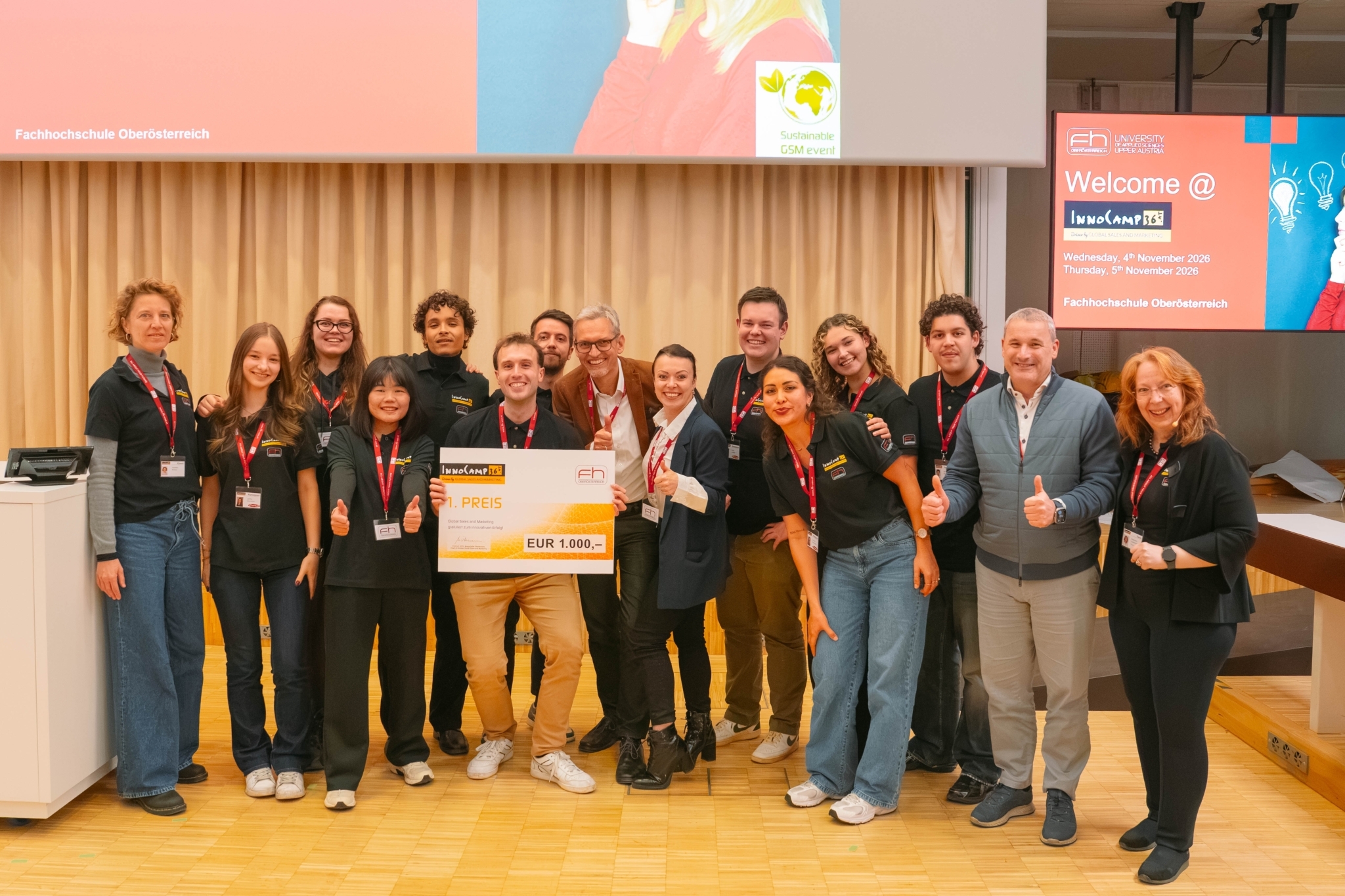
The Steyr student team presenting innovative energy-saving solutions, together with Michael Schubert (8th from left), Jasmin Böhm (9th from left), andHarald Langeder (2nd from right) from Fronius, andMargarethe Überwimmer, Head of the Global Salesand Marketing (GSM) degree program. Photo credit: FH OÖ
Energy communities offer consumers an opportunity to reduce both electricity costs and grid fees. Fronius has launched a nationwide citizen energy community in Austria that makes solar power accessible to everyone, including households and businesses without their own photovoltaic (PV) system. Fronius challenged a mixed team of students from Steyr and secondary school students to raise awareness of its energy community among households and small businesses while also exploring opportunities to expand the business model.
The team identified four key barriers preventing participation in energy communities and developed a comprehensive set of measures to address them under the slogan “No Roof? No Problem!”
What is currently preventing consumers from joining an energy community that could help them save money? “According to our analysis, the main barriers are low awareness, the misconception that owning a photovoltaic (PV) system is required, a confusing registration process, and benefits that are not immediately apparent,” says Elias Gatterbauer, a student in the Global Salesand Marketing master's program at the University of Applied Sciences Upper Austria in Steyr.
FH-Prof. PD Dr. Andreas Auinger, Dean of the Steyr Faculty at the University of Applied Sciences Upper Austria, sees the project as confirmation that the energy transition will not be determined by technology alone, but also by the ability to engage people with new solutions. “This is exactly where our students made an impact: they developed a communication strategy for Fronius that makes energy communities attractive and easy to understand, even for people who do not own a PV system. It is a tangible example of what practice-oriented higher education can achieve.”
Cities Compete for Energy Community Members In addition to the “No Roof? No Problem!” campaign, Gatterbauer and his fellow students propose an annual competition among cities to achieve the highest participation rates in the energy community. Under their concept, the winning city would receive a photovoltaic (PV) system for a public building as a prize. At the same time, local residents would benefit from lower electricity bills by joining the energy community.
The students’ referral concept relies on trusted local partners, such as electrical contractors, to recommend membership to households without PV systems. Associations, community organizations, and housing developers could also serve as important multipliers. Private individuals, meanwhile, could receive product vouchers for successfully recommending the energy community to friends, family, or neighbors.
The team further recommends that Fronius provide personalized energy-saving tips and share local success stories to strengthen customer relationships and increase the appeal of the energy community among cost-conscious prospective members.
InnoCamp36: A Breeding Ground for Future Management Talent The student team had just 36 hours to develop its concept as part of InnoCamp36, an innovation challenge organized by the Global Salesand Marketing degree program. Working in international teams and supported by faculty coaches, participants competed to develop solutions for real-world business challenges. In the final pitch competition, Gatterbauer and his teammates secured first place among nine teams.
Ing. Harald Langeder, Chief Technology Officer (CTO) at Fronius, praised the results delivered by the winning team: “InnoCamp36 is an excellent example of how tradition and innovation can come together, bringing together people from partner companies and the next generation of professionals. While established ways of thinking can sometimes limit new perspectives, these challenges are met with the fresh ideas of students. We are delighted that the Fronius project team was able to present innovative, solar-powered ideas and provide valuable new impulses.”
Learning with a Real-World Impact “The exchange of ideas, the creativity, and the shared enthusiasm for innovation made InnoCamp36 an unforgettable experience. Its innovative teaching approach created lasting value for students, pupils, and participating companies alike,” says FH-Prof. Dr. Margarethe Überwimmer, Head of the Bachelor’s and Master’s degree programs in Global Salesand Marketingand founder of InnoCamp36.
Second place went to a project exploring the future of the urban real estate and housing market, using a historic townhouse in Steyr as a case study. Third place was awarded to a team that developed a concept for KEBA in Linz, demonstrating how customer feedback can be systematically collected and leveraged to support change management processes.
Other companies supporting InnoCamp36 included Brau Union, Nimbuscloud, Plasser Scandinavia, Rosenbauer, voestalpine, andWeber Hydraulik.