Hagenberg Graduates Honored for Master’s Thesis at European Modeling and Simulation Conference in Genoa
“Best Paper Award" in the Field of Embedded Systems
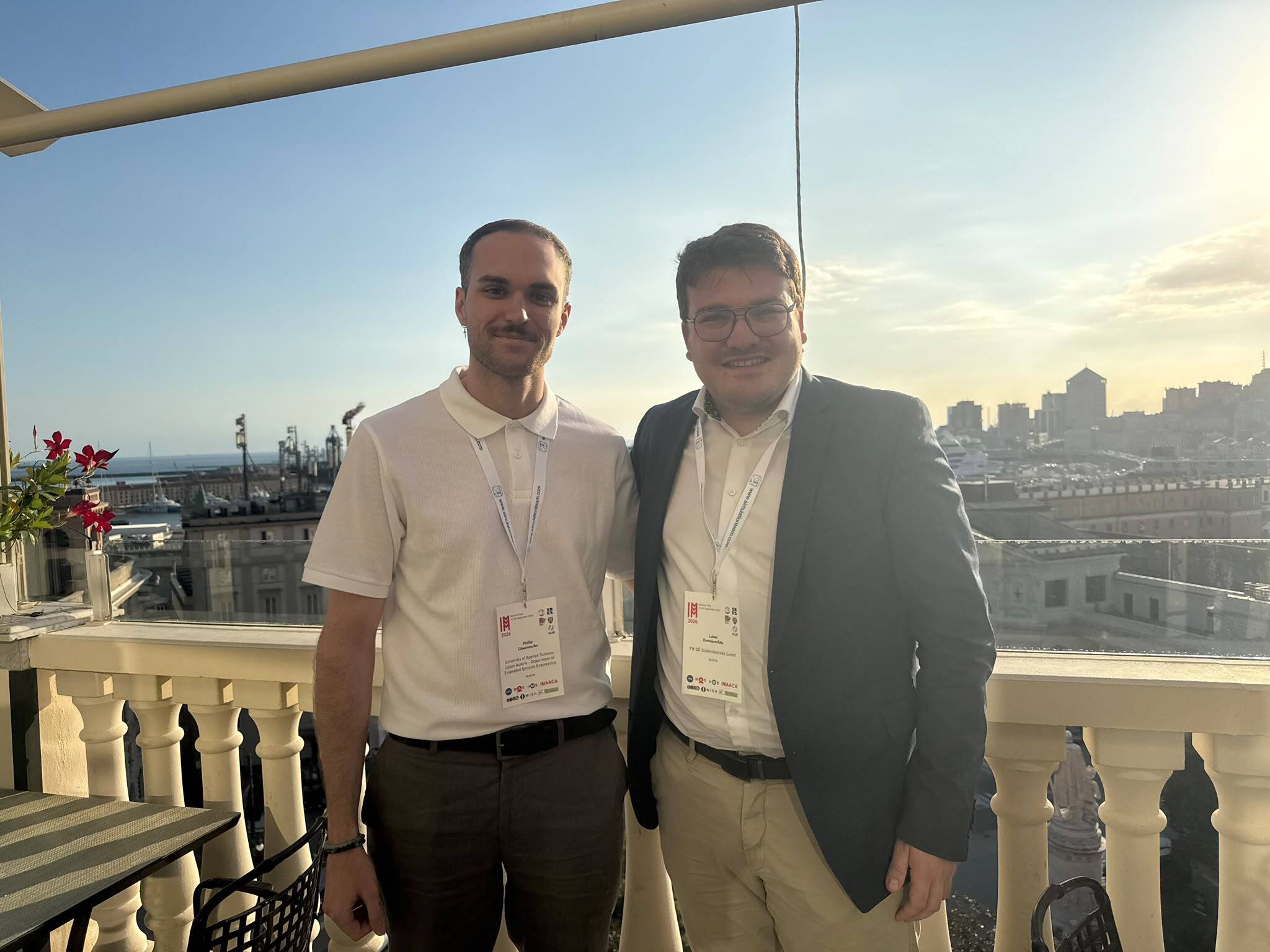
Lukas Damianschitz and Phillip Oberndorfer, graduates of the Embedded Systems Design master’s program at the University of Applied Sciences Upper Austria, Hagenberg Campus, presented their research findings at the European Modeling & Simulation Symposium (EMSS).
Photo credits: Lukas Damianschitz and Phillip Oberndorfer
Lukas Damianschitz and Phillip Oberndorfer successfully completed the Embedded Systems Design (ESD) program at the University of Applied Sciences Upper Austria, Hagenberg Campus. The two graduates from Lower Austria had the opportunity to present their master’s theses as conference papers at one of Europe’s leading simulation conferences. The quality of their research in the fields of facial recognition and AI as well as runtime latency analysis impressed the review committee, and Lukas Damianschitz ultimately returned home with the Best Paper Award. The conference focuses on the application of modeling and simulation in industry, making it an excellent fit for the practice-oriented and industry-focused approach to education in Hagenberg.
“In his thesis, Lukas Damianschitz successfully brought together the highly topical issues of facial recognition, privacy, and the AI Act,” says Josef Langer, Professor at the University of Applied Sciences Upper Austria. “Embedded systems have tremendous potential to address these challenges because they enable computations to be performed directly on the device rather than in the cloud, making privacy by design possible.”
The concept of privacy by design incorporates the protection of personal data from the earliest stages of technology development. Langer is well positioned to assess this potential: in addition to coordinating the Embedded Systems Design (ESD) master’s program at the University of Applied Sciences Upper Austria, Hagenberg Campus, he also heads the institution’s Embedded Systems research group.
“I am absolutely delighted by the success of our two alumni, which is a testament to the high quality of education in Hagenberg,” says Stefan Wagner, Dean of the Hagenberg Campus of the University of Applied Sciences Upper Austria. “Having the opportunity to present one’s master’s thesis at an international scientific conference is already a remarkable achievement in itself. Earning a Best Paper Award on top of that makes it an outstanding and truly exceptional accomplishment.”
Bridging Technology and Regulation
“My paper demonstrates how facial recognition can run directly on small embedded devices without requiring images or personal data to be sent to the cloud,” explains Lukas Damianschitz. According to Damianschitz, the data remains where it is generated: “This provides significantly stronger protection and ensures compliance with the GDPR.”
The award he received in Genoa is, in the words of the ESD graduate from Laa an der Thaya, “a great recognition” and, on a broader level, confirmation that data protection and advanced technology do not have to be at odds with one another.
Analyzing Delays in Software Systems
Like his colleague’s work, Phillip Oberndorfer’s paper was also based on his master’s thesis in the Embedded Systems Design (ESD) program. Originally from Tulln, Oberndorfer focused on the runtime latency analysis of IP camera streaming systems, developing a method for continuous, software-based monitoring of latency, or delays, directly within the streaming pipeline.
“The goal,” Oberndorfer explains, “is to continuously know the exact delay between capturing a video frame and displaying it on screen.”
Asked what presenting in Genoa meant to him, Oberndorfer says: “It is a fitting culmination of my academic journey to have the opportunity to present my work at an international conference and to have a publication bearing my name.”
What’s Next on Their Career Path?
Lukas Damianschitz is already working as an Embedded Systems Engineer, developing GDPR-compliant systems, and plans to continue pursuing this career path.
Phillip Oberndorfer, meanwhile, has been working since April for a company in Vienna that develops augmented reality (AR) glasses, where low latency is also a critical factor. His expertise in latency analysis therefore aligns closely with the challenges of his current role.
The Right to Award Doctorates: A Boost for Academic Careers at Universities of Applied Sciences
To provide young talents such as Lukas Damianschitz and Phillip Oberndorfer with the option of pursuing an academic career, Austria’s Universities of Applied Sciences (UAS) have long been advocating for the right to award doctoral degrees in their respective areas of research excellence and development.
As Austria’s leading research-intensive University of Applied Sciences, the University of Applied Sciences Upper Austria is particularly well positioned to confer doctoral degrees. With more than 500 projects annually spanning application-oriented basic research and applied research, the institution offers a strong foundation for doctoral education. In 2025 alone, 17 doctoral dissertations were completed, while 90 additional dissertations are currently underway.
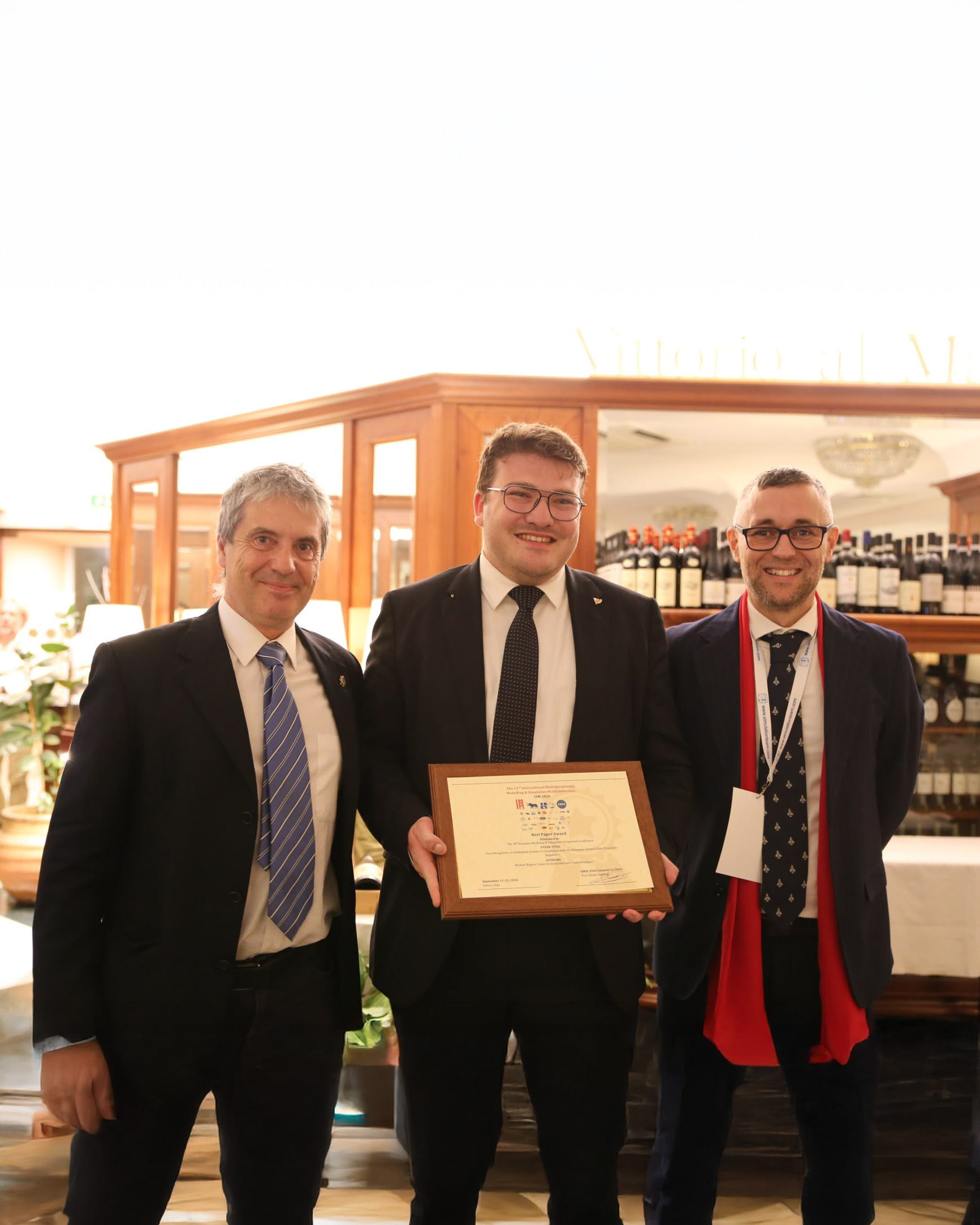
Lukas Damianschitz was ultimately honored with the conference’s “Best Paper Award.”
Photo credits: Lukas Damianschitz und Phillip Oberndorfer


Stay informed and receive all Event- und Study-News.
Quick Links
I'll help you choose your study program.