Upper Austria University of Applied Sciences Heads for Mars
Robotics Expertise from Wels Supports Austrian Space Forum’s Mars Mission Simulation
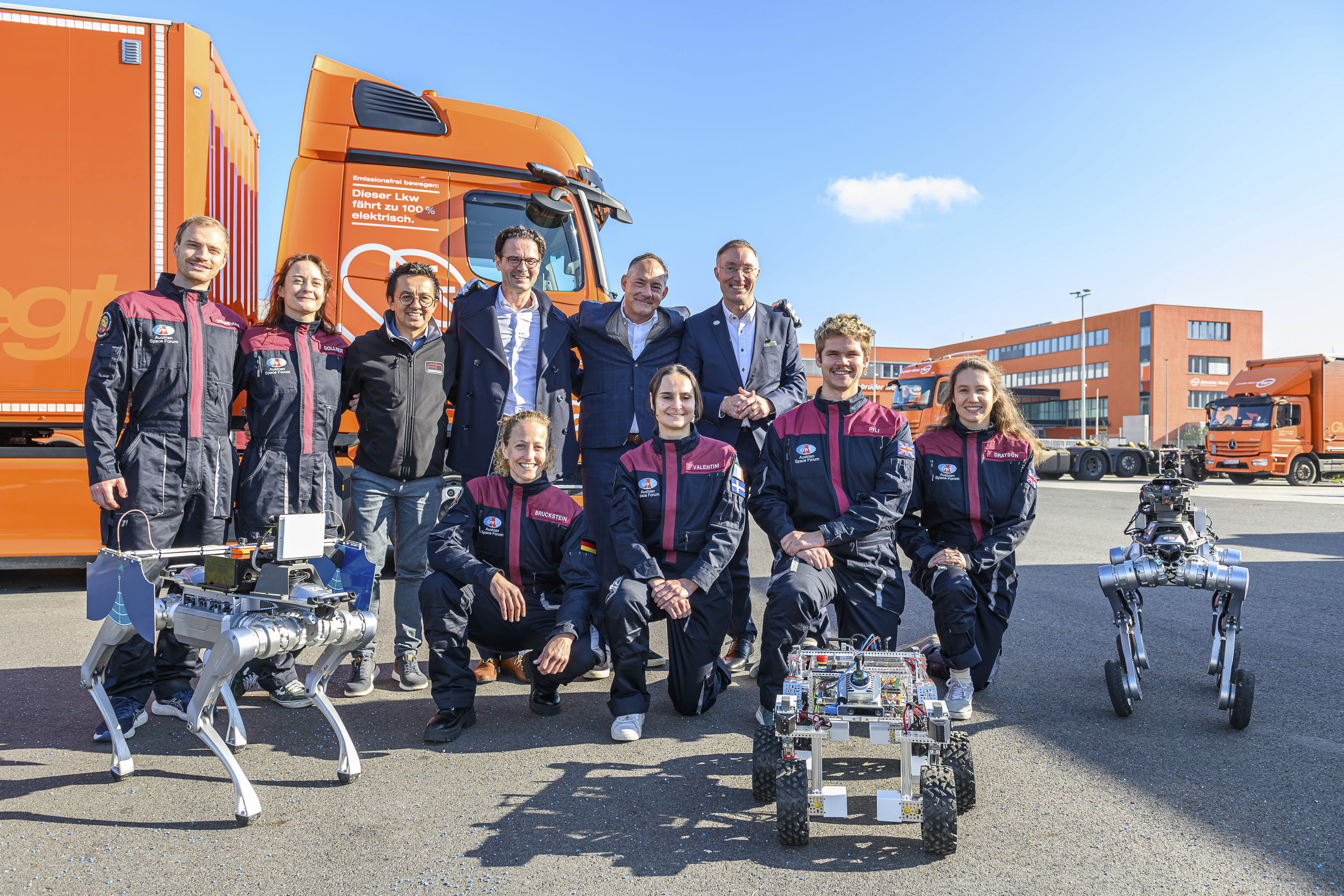
“AMADEE-27 is an important step toward testing technologies for future human and robotic Mars exploration under realistic operational conditions. Close collaboration between humans and robots is at the heart of the mission,” says FH Assistant Professor Raimund Edlinger (third from left). Standing beside him are Michael Rabl, President of the Upper Austria University of Applied Sciences, Klaus Bannwarth, Branch Manager of Gebrüder Weiss in Wels, and Gernot Grömer, Director of the Austrian Space Forum (OeWF). They are joined by the international analog astronauts participating in the mission simulation.
Photo credits: Gebrüder Weiss
Mars remains one of the most ambitious destinations in international space exploration. To make a crewed mission to the Red Planet possible in the coming decades, extensive preparation is required across numerous scientific disciplines. In April 2027, six so-called analog astronauts will conduct a mission simulation in Portugal to explore how humans might live and carry out research on Mars. Coordinated by the Austrian Space Forum (OeWF), the mission will test technologies, scientific methods, operational procedures, medical concepts, and robotic vehicles known as rovers under Mars-like conditions.
This is where the Upper Austria University of Applied Sciences robotics team from Wels comes into play. The researchers are contributing their expertise to the creation of a three-dimensional environmental model of the Martian terrain, helping to support future human and robotic exploration missions.
The AMADEE-27 mission features 17 experiments developed by more than 20 scientific institutions from Austria, Europe, and the United States.
Experts from Wels investigate surface and subsurface structures
FH-Ass.-Prof. Dr. Raimund Edlinger and his team at the Upper Austria University of Applied Sciences, Wels Campus, contribute their expertise in the development of autonomous robotic systems.
"We are integrating a Raman spectrometer and a ground-penetrating radar (GPR) system onto a quadruped robot. By combining these sensors with the robot's integrated LiDAR systems, we create a comprehensive three-dimensional model of the environment that captures both the terrain surface and subsurface structures," explains Edlinger, outlining the objectives of the Wels contribution to the Mars mission.
The robot is designed to support the analog astronauts during extravehicular activities, for example by exploring the terrain, identifying geological formations, and analyzing potentially interesting samples.
"For my team and me, this training provides an exciting opportunity to apply our expertise in rescue robotics to the space sector," says robotics expert Raimund Edlinger. He hopes that AMADEE-27 will also open up new opportunities for future research collaborations and space-related applications, marking an important step from terrestrial to extraterrestrial robotics.
Interdisciplinary Team at the "Mission Control Center"
The analog astronauts at the Mars test site in Portugal are connected to the mission control center in Austria with a realistic communication delay of ten minutes. Whenever they leave their habitat, the analog astronauts wear spacesuits.
Experts in engineering, space science, medicine, robotics, and meteorology provide a detailed schedule for each mission day, as well as the technical and scientific support required to carry out the experiments. They also continuously monitor the crew’s health and well-being throughout the mission.
Trial Run for AMADEE-27 in Wels
At the end of October, the Gebrüder Weiss site in Wels was transformed into a test field for AMADEE-27, where the Austrian Space Forum and the Upper Austria University of Applied Sciences tested scientific experiments and technical systems for the mission.
Members of the media had the opportunity to experience the research activities firsthand and observe the rover developed by the Upper Austria University of Applied Sciences in action.
Robotics as a Core Technological Strength at the Upper Austria University of Applied Sciences
"The Upper Austria University of Applied Sciences is deeply rooted in the region while achieving success on an international scale. Our students and researchers continue to demonstrate this impressively: in 2025, Team DYNAMICS won both the RoboCup Rescue League and Eurobot, and in 2026 successfully defended its RoboCup world championship title. These achievements reflect the powerful combination of excellent applied teaching and research, dedicated teams, and international collaboration. It is precisely these strengths that we aim to further expand and make even more visible globally through our FH OÖ 2040 strategy.
As the future UAP – University of Applied Sciences Upper Austria, participation in AMADEE-27 is therefore a natural next step. We are bringing our expertise in autonomous robotics into an international research environment and extending our sphere of impact all the way into space, albeit virtually for now," says FH-Prof. DI Dr. Michael Rabl, President of the Upper Austria University of Applied Sciences.
Upper Austria University of Applied Sciences as a Key Partner of the Austrian Space Forum
"We are delighted that the Upper Austria University of Applied Sciences is participating in an AMADEE mission of the Austrian Space Forum for the second time and will be represented with a rover developed in-house. This is a powerful demonstration that innovation and technological excellence have a strong foundation in Austria.
Particularly valuable is the opportunity for students to apply the knowledge they have acquired in the context of such an exciting and internationally oriented research project, while growing through real-world technical challenges. This close connection between education, research, and innovation is something we deeply value as well, as it provides the foundation for nurturing young talent and turning innovative ideas into practical solutions," says Dr. Gernot Grömer, Director of the Austrian Space Forum.
Gebrüder Weiss Ensures Seamless Logistics
Through its involvement in AMADEE-27, Gebrüder Weiss is serving as the official logistics partner of the Austrian Space Forum for a Mars analog mission for the third time.
"A Mars analog mission can only succeed if the logistics are in place. That is why we are pleased to contribute our expertise to AMADEE-27 and support the Austrian Space Forum for the third time as its official logistics partner. Our team in Wels ensures that the sensitive research equipment is transported safely and on schedule from Austria to Portugal," says Klaus Bannwarth, Branch Manager of Gebrüder Weiss Wels.
About the Austrian Space Forum
The Austrian Space Forum (ÖWF), headquartered in Innsbruck and Vienna, is one of Europe’s leading institutions for space analog research. With more than 250 members from over 20 countries, the organization conducts Mars analog missions, contributes to two satellites dedicated to the study of space debris, carries out scientific research, and develops technological innovations for future space missions.
During its missions, analog astronauts test technologies, scientific experiments, and operational procedures in Mars-like environments on Earth to prepare for future human missions to Mars. AMADEE-27 is the 16th Mars analog mission conducted by the Austrian Space Forum.
For more information, visit www.oewf.org.
About Gebrüder Weiss
Gebrüder Weiss Holding AG, headquartered in Lauterach, Austria, is a globally operating full-service logistics provider with approximately 8,600 employees and 180 company-owned locations worldwide. In 2025, the company generated annual revenues of €2.72 billion.
Its portfolio includes transportation and logistics solutions, digital services, and supply chain management. By combining digital expertise with a strong physical network, the company is able to respond quickly and flexibly to customer needs.
Through a wide range of environmental, economic, and social initiatives, the family-owned business pursues a long-term sustainability strategy. With a history in transportation spanning more than 500 years, Gebrüder Weiss is one of the world's oldest logistics companies.
For more information, visit www.gw-world.com.
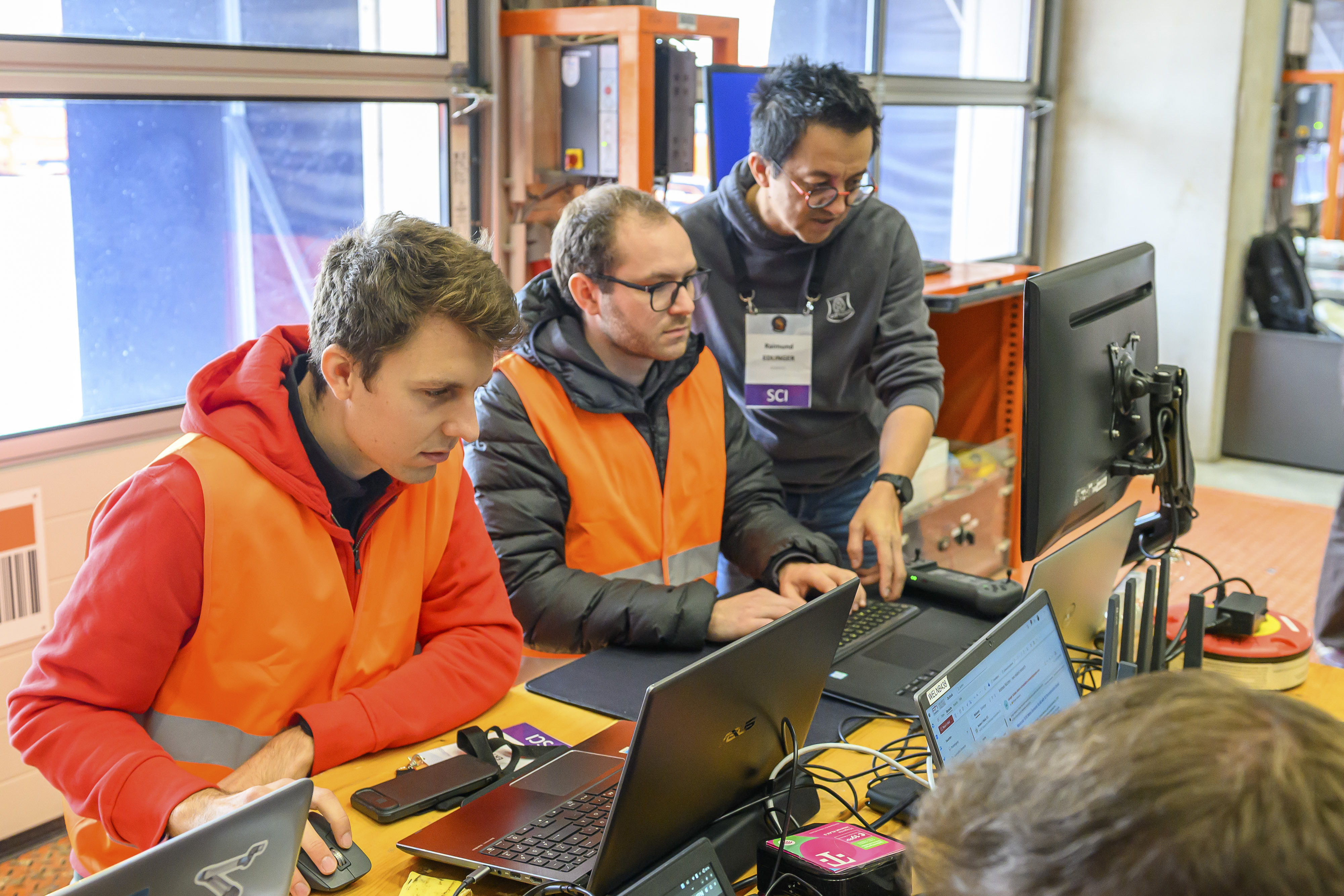
Autonomous robots must not only be capable of navigating challenging terrain but also of carrying out scientific tasks and supporting astronauts during exploration activities. Pictured here, FH-Ass. Prof. DI Dr. Raimund Edlinger and his team are preparing the rover for the mission.
Photo credits: Gebrüder Weiss


Stay informed and receive all Event- und Study-News.
Quick Links
I'll help you choose your study program.